Properties of the Sequence $a_b(n)$
Let $a_b(n)$ be the number of integer tuples $(x_1, x_2, \ldots, x_{k+1})$ where $0 \leq x_i \leq b-1$, such that $|x_i - x_{i+1}| = d_i$ for all $i$, where $(d_1, d_2, \ldots, d_k)$ are digits of $n$ in base $b$.
1. Normal Form Definitions
$\left\langle\begin{array}{c}a_1 \\ a_2\end{array}\right\rangle_b$ is in 'normal form' when:
- $a_1 \leq a_2 \leq b-1$
- $0 \leq a_1\leq a_2$
- $b \geq 1$, where $a_1, a_2 \in \{0, 1, 2, 3, \ldots\}$
2. Rules to convert $\left\langle\begin{array}{c}a_1 \\ a_2\end{array}\right\rangle_b$ into normal form:
- $\left\langle\begin{array}{c}a_1 \\ a_2\end{array}\right\rangle_b = \left\langle\begin{array}{c}0\\a_2\end{array}\right\rangle_b$ if $a_1<0$ and $0 \leq a_2 \leq b-1$
- $\left\langle\begin{array}{c}a_1 \\ a_2\end{array}\right\rangle_b = \left\langle\begin{array}{c}a_1 \\ b-1\end{array}\right\rangle_b$ if $a_2 > b-1$ and $0 \leq a_1 \leq b-1$
- $\left\langle\begin{array}{c}a_1 \\ a_2\end{array}\right\rangle_b = \left\langle\begin{array}{c}0\\ b-1\end{array}\right\rangle_b$ if $a_1 < 0$ and $a_2 > b-1$
- $\left\langle\begin{array}{c}a_1 \\ a_2\end{array}\right\rangle_b = \langle\rangle$ if $a_1 > a_2$
- $\left\langle\begin{array}{c}a_1 \\ a_2\end{array}\right\rangle_b = \langle\rangle$ if $a_1, a_2 < 0$ or $a_1, a_2 > b-1$
3. Normal Form for Sequences
$\left\langle a_1, a_2, \ldots, a_k\right\rangle_b$ where $a_i\in \{0, 1, 2, 3, \ldots\}$ is in 'normal form' when $0 \leq a_i \leq b-1$ for $i \in\{1,2,3, \ldots, k\}$.
4. Rule to convert $\left\langle a_1, a_2, \ldots, a_k\right\rangle_b$ into normal form:
Remove all $a_i$ which are $<0$ or $> b-1$.
5. Operations
- $\left\langle a_1\right\rangle_b=\left\langle\begin{array}{c}a_1 \\ a_1\end{array}\right\rangle_b$
- $\left\langle a_1\right\rangle_b + \left\langle a_2\right\rangle_b + \ldots + \left\langle a_k\right\rangle_b = \left\langle a_1, a_2, \ldots, a_k\right\rangle_b$
- $\left\langle a_1\right\rangle_b + \left\langle a_1+1\right\rangle_b + \ldots + \left\langle a_2\right\rangle_b = \left\langle\begin{array}{c}a_1 \\ a_2\end{array}\right\rangle_b$
- $\left\langle a_1\right\rangle_b + \ldots(m\text{ times})= m\left\langle a_1\right\rangle_b$
- $m\left\langle a_1, a_2, \ldots, a_k\right\rangle_b=m\left\langle a_1\right\rangle_b + m\left\langle a_2\right\rangle_b + \ldots + m\left\langle a_k\right\rangle_b$
- $\left\langle a_1\right\rangle_b - \left\langle a_1\right\rangle_b = \langle\rangle$
- $\left\langle a_1\right\rangle_b \pm \langle\rangle = \left\langle a_1\right\rangle_b$
- $m\left[a\left\langle\begin{array}{c}a_1 \\ a_2\end{array}\right\rangle_b \pm c\left\langle\begin{array}{c}c_1 \\ c_2\end{array}\right\rangle_b \pm \ldots\right] = ma\left\langle\begin{array}{c}a_1 \\ a_2\end{array}\right\rangle_b \pm mc\left\langle\begin{array}{c}c_1 \\ c_2\end{array}\right\rangle_b \pm \ldots$
6. Functions
- $\left\langle\begin{array}{l}a_1 \\ a_2\end{array}\right\rangle_b(0)=\left\langle\begin{array}{l}a_1 \\ a_2\end{array}\right\rangle_b$
- $\left\langle a_1, a_2, \ldots, a_k\right\rangle_b(0)=\left\langle a_1, a_2, \ldots, a_k\right\rangle_b$
- $\left\langle\begin{array}{l}a_1 \\ a_2\end{array}\right\rangle_b(m)=\left\langle\begin{array}{l}a_1-m \\ a_2-m\end{array}\right\rangle_b+\left\langle\begin{array}{l}a_1+m \\ a_2+m\end{array}\right\rangle_b$
- $\left\langle a_1, a_2, \ldots, a_k\right\rangle_b(m)=\left\langle a_1-m, a_2-m, \ldots, a_k-m\right\rangle_b + \left\langle a_1+m, a_2+m, \ldots, a_k+m\right\rangle_b$
- $\left\langle\begin{array}{l} a_1 \\ a_2 \end{array}\right\rangle_b\left(n_1, n_2, \ldots, n_m\right) = \left\langle\begin{array}{l} a_1-n_1 \\ a_2-n_1 \end{array}\right\rangle_b\left(n_2, n_3, \ldots, n_m\right)+\left\langle\begin{array}{l} a_1+n_1 \\ a_2+n_1 \end{array}\right\rangle_b\left(n_2, n_3, \ldots, n_m\right)$
- $\left\langle a_1, a_2, \ldots, a_k\right\rangle_b\left(n_1, n_2, \ldots, n_m\right) = \left\langle a_1-n_1, a_2-n_1, \ldots, a_k-n _1\right\rangle_b\left( n_2, n_3, \ldots, n_m \right) + \left\langle a_1+n_1, a_2+n_1, \ldots, a_k+n _1\right\rangle_b\left( n_2, n_3, \ldots, n_m \right)$
7. Value (calculated only in normal form)
- $|\langle\rangle|=0$
- $|\left\langle\begin{array}{l}a_1 \\ a_2\end{array}\right\rangle_b| = a_2-a_1+1$
- $|\left\langle a_1, a_2, \ldots, a_k\right\rangle_b|=k$
- $|\left\langle a_1\right\rangle_b+\left\langle a_2\right\rangle_b+\ldots+\left\langle a_k\right\rangle_b| = |\left\langle a_1\right\rangle_b|+|\left\langle a_2\right\rangle_b|+\ldots+|\left\langle a_k\right\rangle_b|$
- $|\left\langle\begin{array}{l} a_1 \\ a_2 \end{array}\right\rangle_b\left(n_1, n_2, \ldots, n_m\right)| = |\left\langle\begin{array}{l} a_1-n_1 \\ a_2-n_1 \end{array}\right\rangle_b\left(n_2, n_3, \ldots, n_m\right)|+|\left\langle\begin{array}{l} a_1+n_1 \\ a_2+n_1 \end{array}\right\rangle_b\left(n_2, n_3, \ldots, n_m\right)|$
- $|\left\langle a_1, a_2, \ldots, a_k\right\rangle_b\left(n_1, n_2, \ldots, n_m\right)| = |\left\langle a_1-n_1, a_2-n_1, \ldots, a_k-n _1\right\rangle_b\left( n_2, n_3, \ldots, n_m \right)| + |\left\langle a_1+n_1, a_2+n_1, \ldots, a_k+n _1\right\rangle_b\left( n_2, n_3, \ldots, n_m \right)|$
Evaluating $a_b(n)$ and Parity Properties
$a_b(n)$ is equal to $|\left\langle\begin{array}{l} 0 \\ b-1 \end{array}\right\rangle_b\left(d_1, d_2, \ldots, d_k\right)|$.
For even base $b$, $a_b(n)$ is even for all $n$. That's because solutions come in pairs: $(x_1,x_2,\ldots,x_{k+1})$ is paired with $(b-1-x_1,b-1-x_2,\ldots,b-1-x_{k+1})$, and for them to be distinct, $b-1-x_i \neq x_i$ for all $i$, or $b -1 \neq 2x_i$, hence $b$ can't be odd in this case. But the only time this happens in odd bases is when all $x_i$ are equal to $(b-1)/2$, but that implies it can only happen in the case where all $d_i$ are 0, and that's only ever the case when $n=0$. So we can say that $a_b(n)$ is always even for $n>0$ and for even bases it's even for all $n$.
We'll prove that:
Proof: This evaluates to $$|\left\langle x+d \right\rangle_b + \left\langle x-d \right\rangle_b + \left\langle x-d+b \right\rangle_b + \left\langle x+d-b \right\rangle_b|$$
Each term's value is 1 if it is valid and 0 if invalid.
$\left\langle x+d \right\rangle_b$ can be in the range $[0,2b-2]$ and obviously if $\left\langle x+d \right\rangle_b$ is in the range $[r_1,r_2]$ then $\left\langle x+d-b \right\rangle_b$ is in the range $[r_1-b,r_2-b]$.
$\left\langle x+d \right\rangle_b$ is valid when it's in the range $[0,b-1]$ and invalid when it's in the range $[b,2b-2]$.
When $\left\langle x+d \right\rangle_b$ is in $[0,b-1]$, i.e., when it's valid, then $\left\langle x+d-b\right\rangle_b$ is in the range $[-b,-1]$. Also $\left\langle x+d-b\right\rangle_b$ is in the range $[-b,b-1]$ and whenever it is invalid, i.e., whenever it's in range $[-b,-1]$, then $\left\langle x+d \right\rangle_b$ is in the range $[0,b-1]$ or valid.
So, we notice:
$\left\langle x+d \right\rangle_b$ is valid $\iff$ $\left\langle x+d-b \right\rangle_b$ is invalid.
Similarly we can conclude:
$\left\langle x-d \right\rangle_b$ is valid $\iff$ $\left\langle x-d+b \right\rangle_b$ is invalid.
This means that the following is true when $d \in \{1,2,3,\ldots,b-1\}$:
Hence proved.
The above theorem directly implies that
When $\left\langle x_1,x_2,\ldots,x_p\right\rangle_b$ is in normal form, $d \in \{1,2,3,\ldots,b-1\}$, and $p$ can be any natural number, therefore this is true in general.
Now consider
and
where $d_k$ isn't 0, $n=d_1\ldots d_{k-1}d_k$ and $m=d_1\ldots d_{k-1}(b-d_k)$.
When we evaluate both of these at $d_1$ all the way up to $d_{k-1}$ then the resulting collection of normal forms would be exactly the same. That implies
and when $n,m, d_1 d_2 \ldots d_{k-1} \neq 0$ we can conclude that
It can also be proven that
And obviously whenever any $d_i=0$ it can be skipped.
Visualizing Parity in Base 20
I'll use all this to show how a pattern arises when the first $b^2$ terms of $a_b(n)$ are arranged on a $10 \times 10$ grid and highlighted $\pmod 4$.
The first $b^2$ terms would be of the form $d_1 d_2$, where $d_1$ is 0 when it's a single digit number. Now
Which equals
when $n$ is a two digit number (when $n$ is one digit that case can be dealt with later).
Now the parity (mod 2) of the term
would determine $a_b(n) \pmod 4$.
When we evaluate this we get
Let's denote the first term by $t_1$ and the second term by $t_2$.
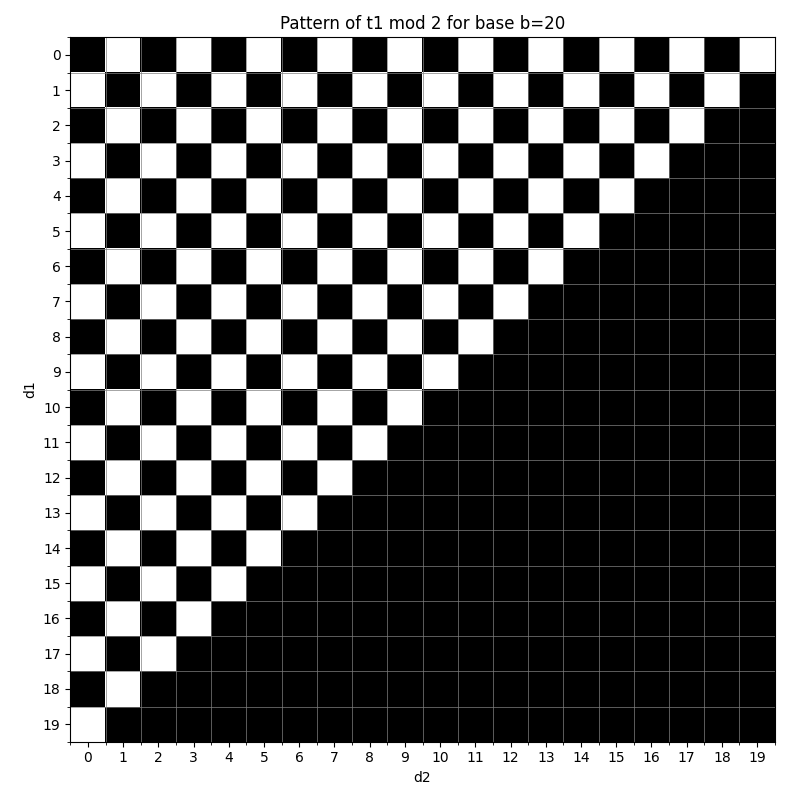
In $t_1$ there could be two cases, either $b-1-d_1-d_2 \geq 0$ or $b-1-d_1-d_2 < 0$. This implies, either $b-1 \geq d_1+d_2$ or $b-1 < d_1+d_2$.
These two cases separate the $b^2$ grid into two distinct regions. Let's call these $R_1$ and $R_2$ respectively. Now in case $R_1$ the value of $t_1$ is $b-d_1-d_2$ and in case $R_2$ its value is 0.
If we only arrange the values of $t_1$ for each cell in the $b^2$ grid and highlight cells mod 2 as $\equiv 0$ would be black and $\equiv 1$ would be white, visually the regions look like this, for base 20:
Analysing $t_2$ we get:
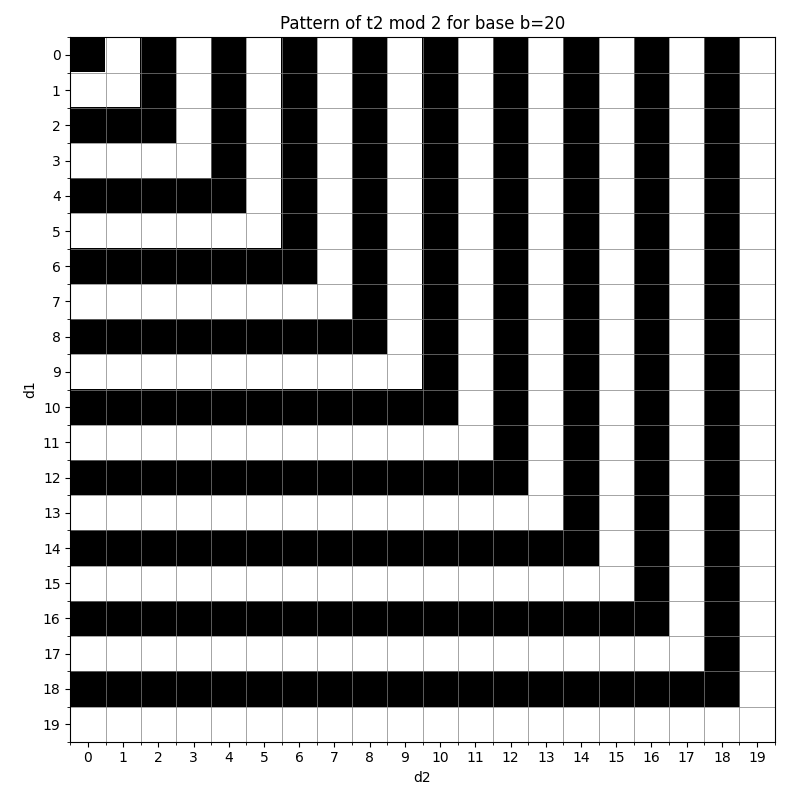
Either $d_1 < d_2$ or $d_1 \geq d_2$ and the values in the regions would be $b-d_1$ and $b-d_2$ respectively. So just like before we use the inequality to determine the two distinct regions and then in each region the values would be plotted mod 2 with their respective formula.
If we choose base 20, the grid for $t_2$ is this:
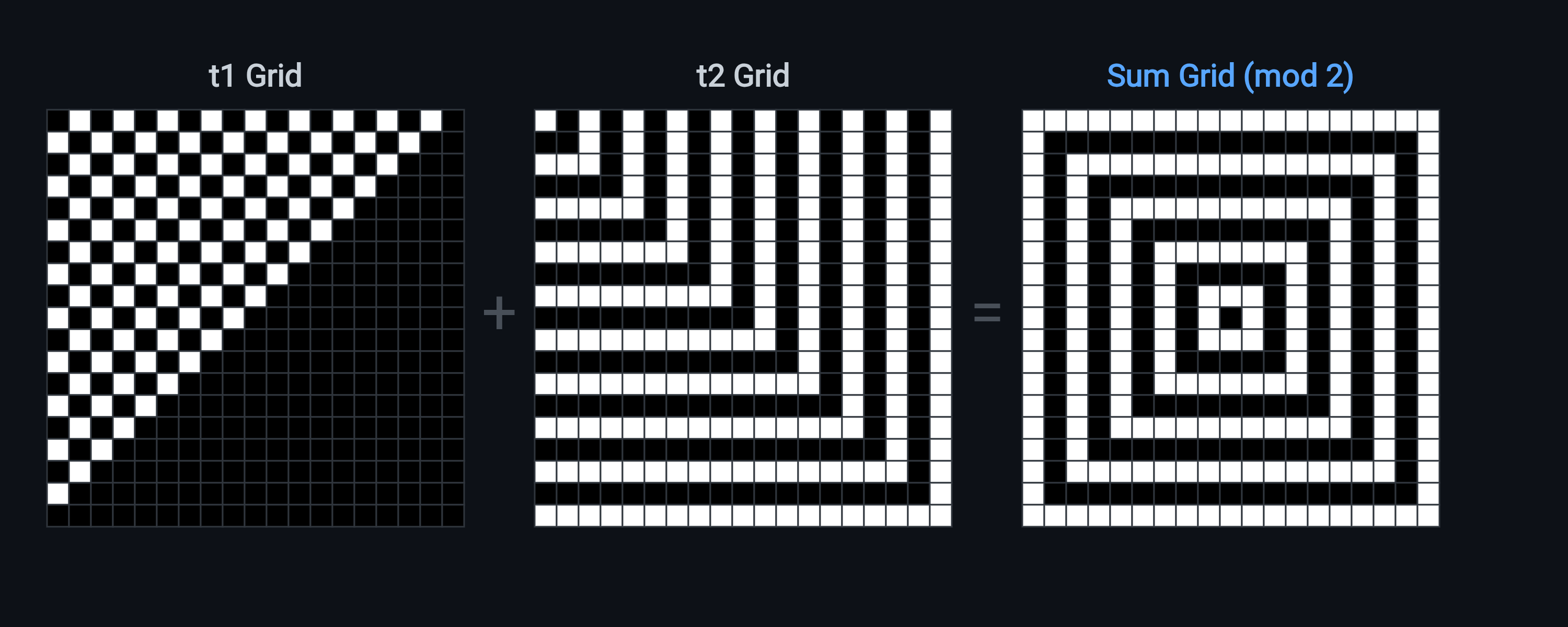
And since $a_b(n)$ is the sum of these two, we can add these two grids visually! Say B is black and W is white, then due to addition mod 2 we would color the cells of the 'sum grid' as $B+B= W+W = B$ and $B+W=W+B=W$.
If we do that we get this:
Of course we need to account for when $d_1$ or $d_2$ is 0. But that's trivial. Similarly, any range of terms can be analysed.